Liverpool dock railway archive · Research release 1.0

From the docks to the Gridiron

Beneath Liverpool, pioneering railway tunnels once carried freight between the Mersey docks and Edge Hill. This is the documented system Jim Jones knew—and the working landscape he remembered exploring as a boy.

One freight machine

Two routes. One railway city.

Ships, dock warehouses, goods stations, tunnels and marshalling sidings formed a connected transport system. The Wapping route served Liverpool's south docks. The Victoria–Waterloo route served the north docks and, later, ocean-liner traffic at Riverside.

Both climbed to Edge Hill, where the Gridiron received, sorted and remarshalled wagons for destinations across Britain. The family's phrase “the Edge Lane Grid Iron” makes geographical sense: the railway complex extended east from Edge Hill towards the Edge Lane, Rathbone Road, Pighue Lane and Olive Mount area.

Wapping Tunnel

The pioneering south-dock route descended from the original 1830 Edge Hill station towards King's Dock and the later Park Lane Goods Station. Loaded wagons first descended by gravity and returned by stationary engine and rope.

  • Opened 1830
  • Length just over 2 km
  • Role south-dock goods traffic
  • Gradient approximately 1 in 48

Victoria & Waterloo

The 1849 north-dock branch ran almost entirely below ground from Edge Hill to Waterloo Goods. Victoria Tunnel met Waterloo Tunnel at the short open cutting between Byrom Street and Fontenoy Street.

  • Opened 1 August 1849
  • Length 2 miles 23 chains for the branch
  • Role north-dock freight; later Riverside passengers
  • Gradient Victoria falls approximately 1 in 57

Explore the routes

Map and 3D rail profile

The plan view uses OpenStreetMap route geometry. The 3D view combines that geometry with published historical gradients to reveal why rope haulage and gravity were central to the system.

Wapping route Victoria–Waterloo route documented landmark

Route geometry: © OpenStreetMap contributors, ODbL. Portal and ventilator coordinates are cross-checked against Historic England and Wikimedia Commons records. Lines show railway alignment, not public access. Do not enter railway land or tunnels.

1826–2026

Two centuries under Liverpool

  1. Parliament authorises the Liverpool & Manchester Railway. Work begins on the route that will include the Wapping Tunnel.

  2. The headings driven from six construction shafts meet, completing the principal excavation.

  3. An opening ceremony is held in the tunnel before regular railway operation begins.

  4. The Liverpool & Manchester Railway opens. Wapping goods wagons descend by gravity and are hauled back towards Edge Hill by rope.

  5. Parliament authorises the branch from Edge Hill towards Waterloo Road and the north docks.

  6. The Victoria and Waterloo tunnel route opens to goods traffic.

  7. The enlarged Edge Hill Gridiron and associated goods lines enter service in stages, joining dock traffic to a much larger gravity-sorting system.

  8. Cable working ends on the Victoria incline. Passenger trains begin using the north-dock route to Liverpool Riverside.

  9. Ventilation improvements permit locomotive working through Wapping Tunnel.

  10. The Liverpool Blitz damages docks, railway routes and Park Lane Goods Station. The goods station remains operational.

  11. Park Lane Goods Station closes. Freight use of the north-dock route ends later in the decade.

  12. The final Riverside passenger service runs in 1971; the principal disused tunnel routes close in the early 1970s.

  13. The Liverpool City Region Long Term Rail Strategy records an initial feasibility study into restoring Wapping Tunnel to passenger use.

  14. Historic England schedules the original Edge Hill engine station, including the first 20 metres of its tunnel portals.

  15. Liverpool Central regeneration moves forward, but the Wapping scheme is not named as a committed project in the reviewed 2025–2040 Delivery Plan.

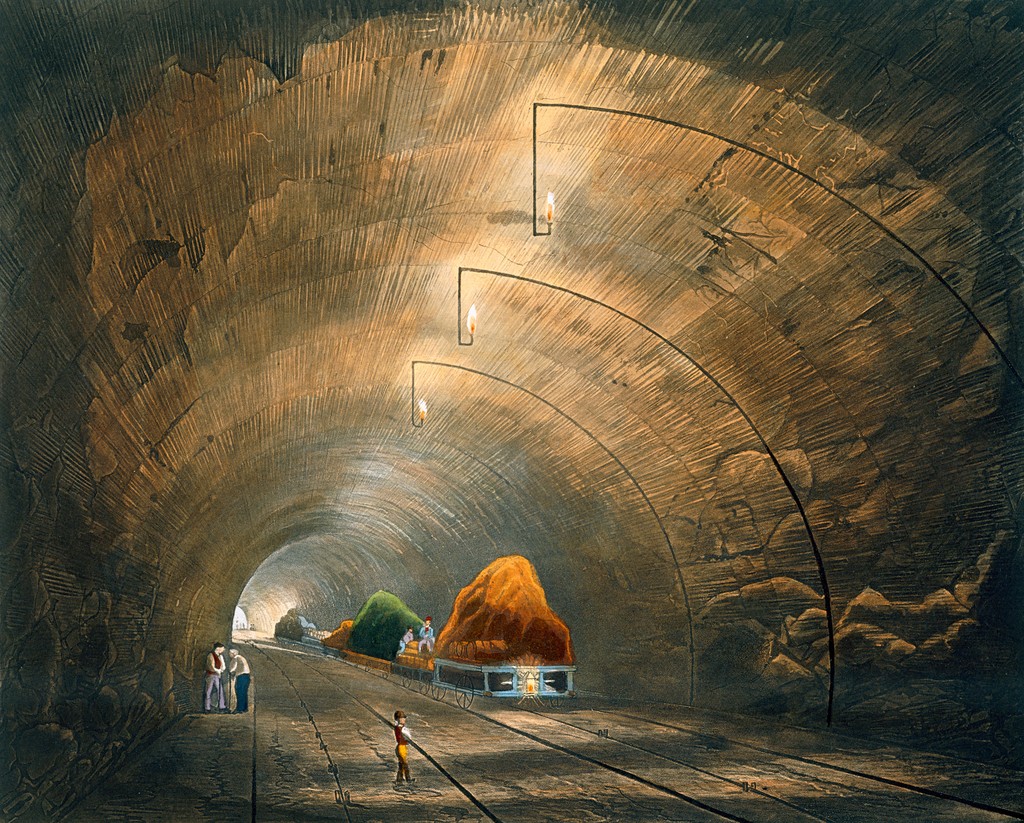
An 1833 coloured print showing railway wagons, workers and visitors inside the illuminated Wapping Tunnel
The Tunnel, T. T. Bury's 1833 revised edition of Coloured Views on the Liverpool and Manchester Railway. Public-domain image via Wikimedia Commons.
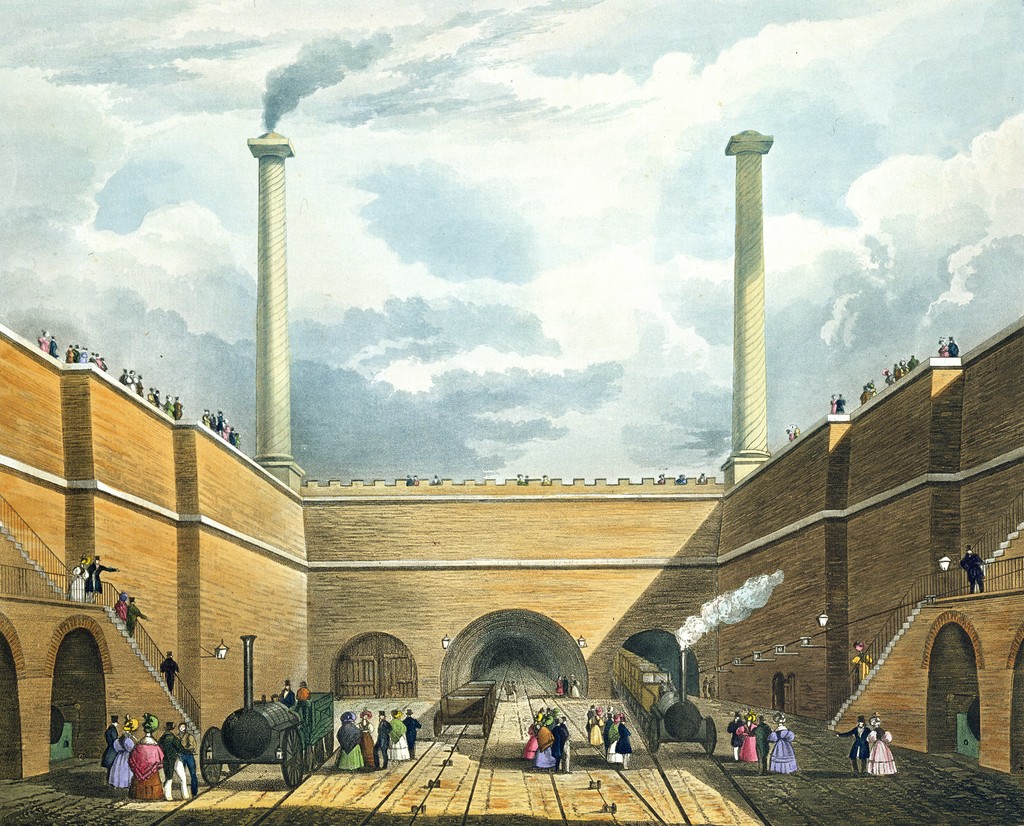
An 1833 coloured print of the original Edge Hill railway station, its Moorish Arch and tunnel entrances
Entrance of the Railway at Edge Hill, T. T. Bury, 1833 revised edition. Public-domain image via Wikimedia Commons.

The Edge Hill Gridiron

How a city sorted wagons by gravity

The Gridiron was not one yard or one tunnel entrance. It was an extensive reception, sorting and departure system. Its diagonal fans of sidings gave it the name railway workers remembered.

LNWR engineer Harry Footner's expanded scheme used Liverpool's natural fall of land. Carefully chosen gradients kept wagons moving through points and crossings, while staff, brakes and chain drags controlled the risks.

01

Receive

Loaded trains climbed from the dock goods stations to reception lines above Edge Hill.

02

Separate

Wagons were released into sorting lines allocated to districts or onward trains.

03

Marshal

Further sidings placed wagons in the station order needed for efficient delivery.

04

Dispatch

Newly formed trains left Liverpool through the main-line goods network.

The railway at war

Damaged, essential, still moving

Liverpool's docks were Britain's western lifeline. During the first eight nights of May 1941, Merseyside was bombed almost continuously. Imperial War Museums records roughly 1,900 deaths, 1,450 serious injuries and 70,000 people made homeless in those raids; transport routes were blocked and around half the dock berths were put out of action.

Historic England records that Park Lane Goods Station, at the dock end of the Wapping route, was extensively damaged but continued operating. The railway did not vanish during the Blitz: bomb damage, emergency repair, freight movement and everyday work existed together.

The National Railway Museum catalogue identifies a three-hour interview with railwayman Edward Horne covering Edge Hill in 1943–46, Gridiron practice, wartime damage, Park Sidings, freight and troop trains. The archive has not yet quoted that recording: it must be heard or transcribed first.

“Jim remembered these tunnels not as a lost curiosity, but as part of the working Liverpool his railway family understood.”
Jones family oral history · record in progress

Jim's testimony

A primary voice, clearly labelled

Jim Jones remembered playing in Liverpool's dock railway tunnels during the Second World War and afterward. His family included railwaymen who knew the routes between the docks and the Edge Hill/Edge Lane Gridiron. Within that community, “the tunnels” meant railway infrastructure—not the better-known road tunnels under the Mersey.

This is family oral history. It is historically plausible and valuable, but the archive will not silently convert memory into an official record. Exact entrances, dates, companions and routes remain questions for a recorded interview and comparison with maps, railway staff records, photographs and other Liverpool families' testimony.

Documented history

Railway records

Routes, dimensions, opening dates, operating methods, wartime damage and statutory protection are stated as facts only where sources support them.

Oral history

Jim's memory

Childhood experiences and railway-family knowledge are attributed directly to Jim and his family, preserving their value and provenance.

Historical fiction

The novel

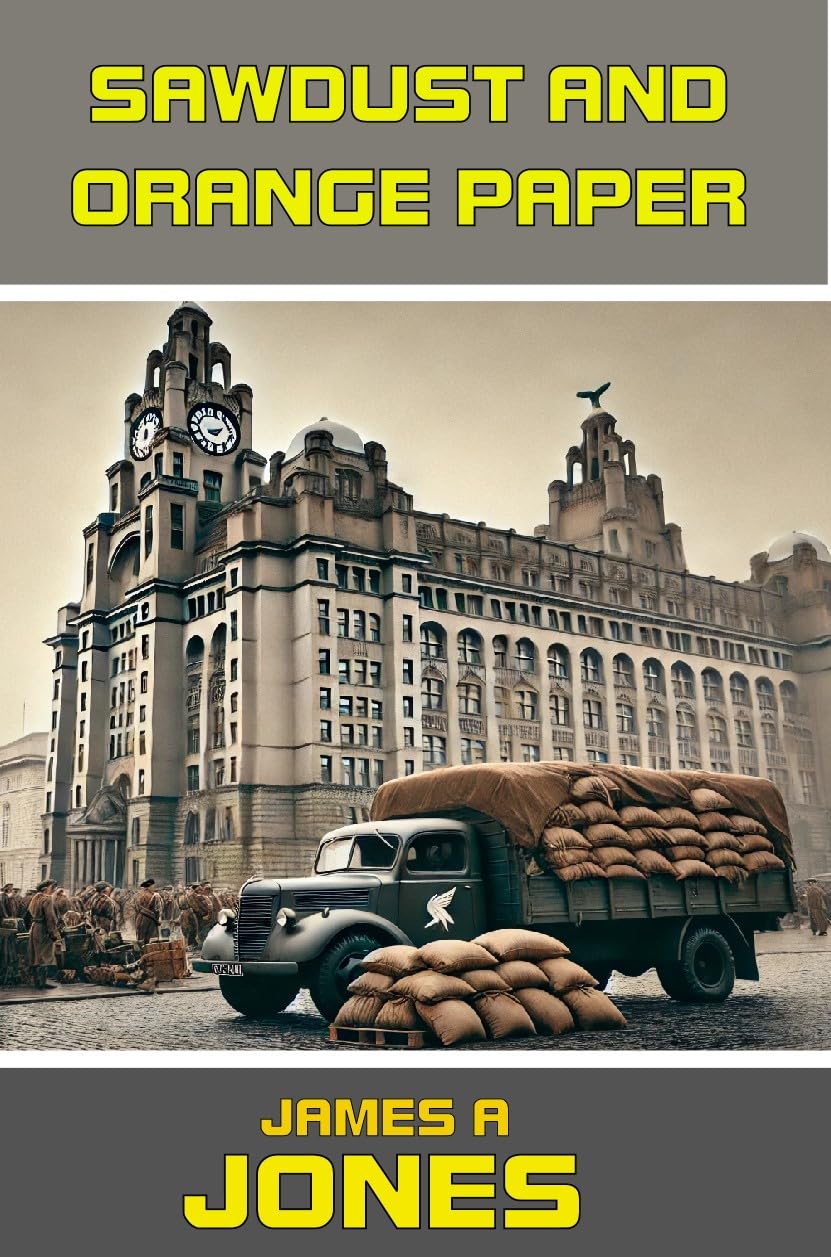
Sawdust and Orange Paper uses a real wartime setting, but its characters and plot remain fiction. The archive does not use the novel as evidence.

Could Wapping reopen?

Studied—but not yet a construction project

The idea is real. Liverpool City Region's 2018 Long Term Rail Strategy said an initial feasibility study had examined bringing Wapping Tunnel back into passenger use. It identified potential to take City Line services to Liverpool Central, improve interchange and relieve Lime Street, with a possible station serving the Knowledge Quarter.

The status needs care. The January 2026 draft Transport Delivery Plan sets out current, 2027–32 and 2032–40 priorities. In the plan and investment maps reviewed for this archive, Wapping Tunnel is not named as a committed delivery scheme. Liverpool Central regeneration is active in 2026, but that is not the same thing as approval to reopen Wapping.

Evidence register

Sources, rights and open questions

This is a living archive, not a mystery-site compilation. Statutory records and infrastructure-owner material lead; specialist railway studies add operating detail; oral history is attributed; and every reproduced image or map must have a usable licence.

  1. Historic England: Edge Hill Engine Station, NHLE 1476078

    Statutory source for the original station, tunnel portals, Wapping's route and operation, Park Lane Goods Station and wartime damage. The monument was scheduled in 2022.

  2. Network Rail: Victoria and Waterloo tunnels

    Current infrastructure-owner description of the near-straight two-mile route between Edge Hill and Vauxhall and the surviving freight-connected portion.

  3. Historic England: Entrance to Waterloo Tunnel, NHLE 1292084

    Grade II listing for the 1847 stone portal beside Edge Hill station, commonly described as the eastern Victoria Tunnel portal.

  4. Subterranea Britannica: Edge Hill and Waterloo Branch Railway

    Detailed specialist history, dimensions and chronology for the 1849 branch, rope working, later locomotive use and closure.

  5. Railway & Canal Historical Society: Railway lines around Edge Hill

    Expert field notes explaining the upper reception sidings and gravity sorting in relation to the surviving railway landscape.

  6. L&NWR Society archive catalogue

    Lists TRACK0009 and TRACK0021: Gridiron descriptions, maps, working methods, staff duties and fourteen 1951 photographs. These are priority archive requests.

  7. National Railway Museum oral-history catalogue

    NAROH2000-52, Edward Horne: Edge Hill, the Gridiron, wartime damage, Park Sidings, freight, troop trains and railway staff. Recording not yet consulted.

  8. Imperial War Museums: The Liverpool Blitz

    Authoritative wartime context for the May 1941 raids, casualties, homelessness and damage to docks and transport.

  9. Liverpool City Region Long Term Rail Strategy, May 2018

    Official record of the initial Wapping passenger-reuse feasibility study and its relationship with Liverpool Central.

  10. Liverpool City Region Transport Delivery Plan 2025–2040, January 2026 draft

    Current, imminent and longer-term delivery priorities used to check whether Wapping is presently a named committed scheme.

  11. OpenStreetMap contributors

    ODbL-licensed route geometry for the interactive plan and 3D alignment. Geometry is a public map representation, not an engineering survey.

  12. Science Museum Group: Wapping Tunnel wire rope

    Surviving material evidence from the rope-worked railway. Object metadata is CC0 and text is CC BY 4.0; image reuse has separate terms.

Map and image policy: public-domain and openly licensed images may be reproduced with attribution. Copyright-restricted Ordnance Survey sheets, Britain from Above photographs and archive plans will be linked to their collection pages until reproduction permission is confirmed. “Available online” does not mean “free to republish.”

Cover of Sawdust and Orange Paper by James A Jones

The human story behind the history

Read Liverpool, 1941

Jim's lived knowledge of Liverpool's railway and dock landscape informs the sense of place behind Sawdust and Orange Paper—a wartime thriller in which convoy losses, black-market activity and sabotage converge on Britain's essential Atlantic port.

View the book on Amazon UK →